Tag Archives | Health

On your knees.

Maybe I’m a bit superstitious, but I don’t like thinking about getting injured skiing. I don’t know — maybe I’m afraid I’ll tempt fate or invoke the evil eye. Silly, I know, but what superstition isn’t?

All the same, I’m intrigued by the large number of ACL injuries that occur, especially among women. The ACL, or Anterior Cruciate Ligament, is one of the four major ligaments in the knee. It controls how far forward the tibia moves under the femur. (The tibia is the larger bone beneath your knee; the femur is your thigh bone).  And it’s the first ligament that tightens when the knee is straightened. If the knee is forced past this point, that’s when trouble begins.

ACL Tear

ACL (from orthogate.org)

According to my research, female athletes are nearly three times more likely to suffer an ACL injury than men — a huge difference.

Which leads to the following question:

Why?

Oddly enough, no one seems to know exactly, though there are a number of theories. I’m no doctor or medical authority of any sort, but they seem to boil down to the following:

• Reduced muscle strength: Women have less muscle strength than men,  so they rely more on the ACL to hold the knee in place. This can make the ligament more prone to rupture.

• Knee alignment: The Q angle, or the angle in which the quadriceps meet the femur, is greater in women than it is in men. Because of this, any twisting action can exert greater force on the ACL than it does in men. This, again, can cause it to rupture.

• Hormones: Yes, yet another thing we can chalk up to these buggers. On the up side, hormones can give women’s ligaments and joints greater flexibility. On the down side, if the other ligaments and muscles around the knee are so loose that they can’t absorb stress, then even normal loads or forces may be transferred directly to the ACL. And this can make it, yes, prone to rupture. Some studies even show that the knee can become even looser than normal at specific points within the menstrual cycle, making ACL ruptures even more common.

• Delayed response: It’s also been determined that women’s muscles that stablize the knee may take a millisecond longer to respond than men’s, and that  this small difference could also lead to injury.

So what’s to be done? Is there anything, apart from not skiing (heaven forbid), that you can do to keep your ACL injury-free?

The good news is yes. Studies show that improving muscular power and strength can help. These are two different things. Strength refers to the amount of force that can be applied to a muscle, and power to the combined factors of speed and strength. Weights and resistance training are good for the former, and plyometric exercises for the latter. Plyometrics are designed to produce fast, explosive movements in which the muscle is loaded and unloaded in rapid sequence.

My advice: if you want to begin any kind of program to help your ACL, consult a good physical trainer. Start your training well in advance, and your knees will thank you next season.

I hope I haven’t jinxed myself by posting this, but since my ski season’s over, I may be safe. All the same, and not being one to take chances, I hope you don’t mind if I include the following picture. Maybe it’ll help.


Read full story · Comments { 10 }

I bet she’d be killer on skis.

Obama came to Vermont last week.

He only buzzed in for the day. Without Michelle. And without skis. Truly, a missed opportunity.

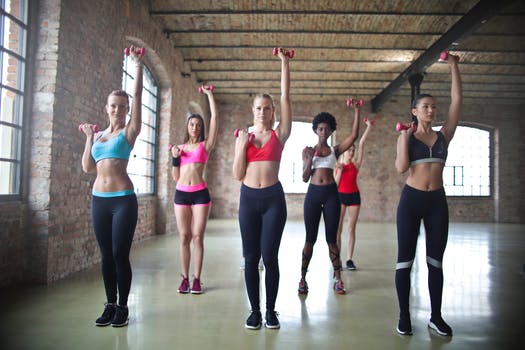
I know the president is a busy man and really doesn’t have time to get out on the slopes. But skiing is perfect for Michelle. Just look at her: you can tell by her arms that she works out. And she’s all about promoting physical fitness and fighting obesity.

As I said, perfect.

Michelle is no stranger to skiing. She and the girls took a ski vacation in Aspen in February. I have no idea how well she skis, but we need to make more of this.The last White House resident I remember skiing is President Gerald Ford. And face it, he just didn’t have the same star appeal as Michelle.

So if you’re reading this, Michelle  – and I’m sure you are  –  listen up: There’s no better way to promote physical fitness than skiing. Think of what an inspiration you’d be to girls and women everywhere (we really need to get more women on the slopes). And what a terrific boost to the ski industry, too. It’s been a tough year, particularly here in Vermont. First we were slammed with Hurricane Irene, then an unseasonably mild winter with below average snowfall cut down on skier visits, which really hurt the state’s economy. We could sure use a boost.

But I digress. What I really wanted to talk about was the health benefits of skiing. Because, Michelle, I know that’s what you’d like to know:

Skiing improves strength and muscle tone. According to the U.S. Ski and Snowboard Association, skiing works the muscle groups known as the “prime movers.” These include the hamstrings, quadriceps, glutes, calves, hip and feet muscles, To a lesser degree, you also use your abdominal muscles for control and work your arms by using poles. So it’s a great all body workout.

Skiing works your cardiovascular system. By elevating your heart rate, skiing can strengthen your heart, which can help move more oxygen and nutrients to your muscles and improve waste removal from the tissues.

Skiing improves flexibility. Skiing forces you to practice balance and precision, which can lead to better flexibility, stability, and balance.

Skiing can help you lose weight. For a person weighing 165 lbs, skiing can burn 450 to 600 calories an hour, while mogul skiing can burn almost 900.  ’Nuff said.

Skiing elevates your mood. When you ski, you release endorphins and adrenaline into the bloodstream, elevating your mood and providing an overall sense of well being. There’ve been all kinds of studies that show a direct relationship between positive thoughts and good health. Plus what could beat having a great time out on the snow?

So Michelle, show the world your inner Ski Diva. I know the season’s winding down, but next year, get out there and show the women of America that skiing is a great way to stay fit and get healthy. And come ski with me in Vermont. I promise you, we’ll have a blast.


Read full story · Comments { 1 }

Ski for the Cure!

Never say that skiers are just out for a good time (though yes, that is part of it).

Recently I posted about K2′s Breast Cancer Research Fundraiser. Now here’s another one that’s ski-related:

To raise money for the Breast Cancer Three Day and Susan G. Komen for the Cure, Kitties for A Cure, an independent group, is raffling off lift tickets for a number of ski resorts in the Northeast. A single raffle ticket costs $1., or you can get a Super Ticket that covers all the areas for $5.

The following have donated tickets to the cause:

Black Mountain, NH
Bromley Mountain, VT
Pat’s Peak, MA
Ragged Mountain, NH
Saddleback, ME
Shawnee Peak, ME
Waterville Valley, NH
Whiteface/Lake Placid, NY

The drawing will be held December 9. You can go to the Kitties For A Cure website to participate or to find out more.


Read full story · Comments { 0 }

The Pink Chase.

That’s the name of K2′s breast cancer fundraiser.

As many of you already know, October is Breast Cancer Awareness Month. And as part of this, the women of K2′s women’s development teams will ski as much vertical, or walk as many kilometers, as they can to raise money for breast cancer research.

Anyone who makes a donation or a pledge though K2 will have the opportunity to win prizes, including a complete K2 Skis package, travel luggage, Polar watch, tickets to Arapahoe Basin and more. The fundraiser runs through October 30, so there’s still time to participate. Go here for more information on how you can participate.

Who among us doesn’t know of someone who has been stricken by this awful disease? Here’s our chance to make a difference. How incredible would it be if there was a cure for this in our lifetime!


Read full story · Comments { 0 }

Skiing and pregnancy.

There are lots of opinions about this. Some people say if you’re a good skier, then there’s no reason pregnancy should interfere with your skiing — as long as you stop before the third trimester, since your center of gravity may be off.

Me, I don’t think it’s worth the risk. There’s never a guarantee you won’t fall or someone won’t collide with you. And there are a lot of worse things than missing a ski season.

Apparently I’m not alone. Three-time Olympian and four-time US slalom champion Sarah Schleper just announced that she’s going to miss the 2008 World Cup season because she’s expecting a baby early next year.

Granted, she skis a lot differently than just about any other woman on the planet. And even though she’s giving up racing, maybe she’ll still take a run or two. The reports I read didn’t say.

Everyone is different. And of course, the final decision is up to you. But if you do plan to ski, discuss it with your doctor. Stay away from double black runs. And be extra careful, okay?


Read full story · Comments { 0 }

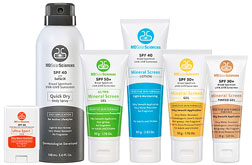
Separating Sunscreen Facts From Fiction.

When I was a kid, I used to slather on the baby oil and sit on the beach and roast. The idea, of course, was to achieve the “perfect tan.” What I usually ended up with was the perfect burn, instead.

What fools we were back then.

Now, of course, we know a lot better. Sun exposure can cause all sorts of damage to your skin, not to mention contribute to skin cancer.

So when I saw this on CNN about common sunscreen “myths”, I knew I had to post it here.

Myth No. 1: Sunscreen is all you need to stay safe.

Reality: “Sunscreen is only one part of the sun-protection picture,” explains Francesca Fusco, M.D., an assistant clinical professor of dermatology at Mount Sinai Medical Center in New York. “Just slathering it on and doing nothing else isn’t going to cut it because, even with sunscreen, there’s still up to a 50 percent risk that you’ll burn.”

You also need to seek shade between 10 a.m. and 4 p.m. when sunlight is strongest; cover up with clothing, a broad-brimmed hat, and UV-blocking sunglasses; do regular skin self-exams; and get a professional skin evaluation annually.

Myth No. 2: SPF measures levels of protection against both UVB and UVA rays.

Reality: The SPF (sun protection factor) measures only the level of protection against UVB rays. But several of the 16 active ingredients approved by the Food and Drug Administration for use in sunscreens also block or absorb UVA rays, says Warwick L. Morison, M.D., professor of dermatology at Johns Hopkins Medical School and chairman of the Skin Cancer Foundation’s Photobiology Committee.

Ingredients include: avobenzone (Parsol 1789), octocrylene, titanium dioxide, and zinc oxide, as well as the recently approved Mexoryl SX. Make sure one of these is in your sunscreen, or look for products labeled “broad spectrum,” which means they protect against UVB and UVA rays.

Myth No. 3: Some sunscreens can protect all day.

Reality: “Regardless of the SPF or what the label says, sunscreens must be reapplied every two hours,” Fusco says. “The active ingredients in most products begin to break down when exposed to the sun.” Only physical blockers such as zinc oxide stay potent after two hours, but not all sunscreens are made with these ingredients.

Myth No. 4: Some sunscreens are waterproof.

Reality: The FDA does not recognize the term “waterproof,” so don’t count on sunscreen to last through hours of swimming. The agency does recognize “water/sweat/perspiration resistant” (which means a product offers SPF protection after 40 minutes of exposure to water) and “very water/sweat/perspiration resistant” (which means it still protects after 80 minutes). To be safe, reapply sunscreen after swimming or sweating.

Myth No. 5: A sunscreen can provide “total sunblock.”

Reality: “No sunscreen blocks 100 percent of UV rays,” Fusco says. An SPF 15 protects against 93 percent of UV rays, SPF 30 protects against 97 percent, and SPF 50 wards off 98 percent. You should slather two tablespoons on your body a half-hour before going outside, so the sunscreen has time to absorb into your skin.


Read full story · Comments { 0 }

Another reason to ski….

…or even exercise: it’ll improve your memory and boost your creativity and reaction time.

Middlesex University researchers in London discovered that 25 minutes of aerobic exercise boosted scores on subsequent creativity tests. And one study found physically fit workers were 12.5 percent more efficient at the end of the day than their nonphysically fit counterparts. What’s more, a study in the journal “Nature” reports that sedentary senior citizens who took up walking for 45 minutes, three days a week, were able to significantly improve mental skills that decline with age.

We all knew we were smart for skiing. This just proves it!

Now if I could just remember where I put those keys…..

Read full story · Comments { 0 }

Ski your way to better sleep.

Have trouble sleeping? Maybe you should ski more.

The National Sleep Foundation reports that exercise in the afternoon can help deepen shut-eye and cut the time it takes for you to fall asleep. However, a 2003 study found that a morning fitness regime was key to a better snooze. Researchers at the Fred Hutchinson Cancer Research Center concluded that postmenopausal women who exercised 30 minutes every morning had less trouble falling asleep than those who were less active. The women who worked out in the evening hours saw little or no improvement in their sleep patterns.

No studies have proven conclusively the best time to exercise, but there’s unanimous agreement that exercise helps you fall asleep better and sleep more restfully.

Hey, it’s as good an excuse as any to hit the slopes.

Read full story · Comments { 0 }