About Wendy

Author Archive | Wendy

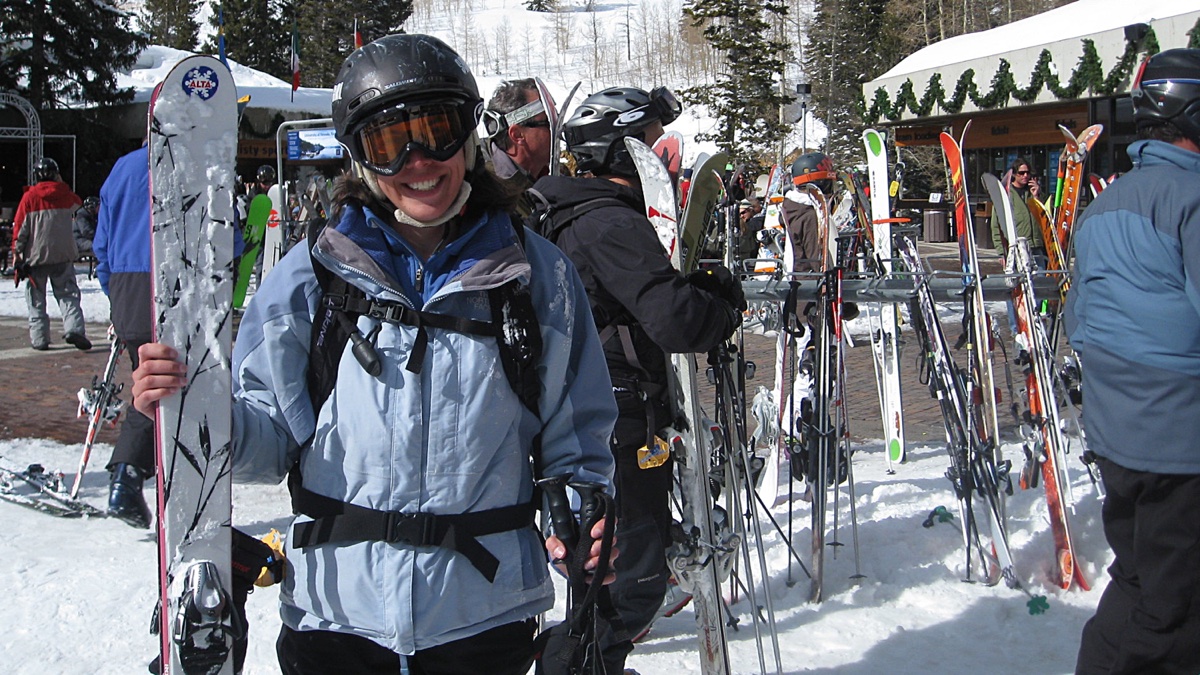
Meet Kristen Lummis, Brave Ski Mom

I couldn’t let Mothers Day week go by without a shout-out to the ski moms. After all, it’s the mom who usually makes sure everyone has the hats, goggles, ski pants, boots, etc. they need. Who dresses and undresses the kids. Assembles the lunches. Hauls the equipment. Harbors a secret stash of tissues/sun block/chap stick/energy bars for that unavoidable emergency. Accommodates multiple bathroom breaks with all the dressing and undressing that go with ‘em. Provides encouragement after a fall. Drives to and from the slopes. Attends ski races. Wipes noses and tears. Administers first aid. Puts on and removes boots/jackets/gloves/helmets. Makes sure nothing gets left behind. Arranges ski lessons. Makes sure the kids wear helmets.

Obviously, being a ski mom isn’t an easy job. But there is help: Kristen Lummis’ outstanding blog, Brave Ski Mom. Kristen writes about anything and everything related to family skiing: resorts, gear, kids, parenting, and more.  There’s a ton of great information, so it’s a great resource for ski moms everywhere. Plus it’s a lot of fun to read.


The Brave Ski Mom Family

I spoke to Kristen recently from her home in Colorado.

Q: How did you get started, and where’d the name Brave Ski Mom come from?
A: I started Brave Ski Mom in late July, 2010, after 16 months of thinking about it. The inspiration came from my older son. When he was 11, we were skiing at Snowbird, UT, and while riding the chairlift, he began going over the points he felt made Snowbird a great place for kids to ski. Listening to him, I realized that he had put a lot of thought into his comments and that they were really insightful. So, I suggested he start a blog. He wasn’t at all interested, but it planted a seed in my brain. A few weeks later, I began writing sample posts and sharing them with family and friends.

My focus for these sample posts was family travel and ski resort reviews. The “where, how, and why” information that is helpful when families are deciding to take a ski vacation. The feedback I got was very positive. But then I got bogged down in the details: the technology, the platforms, hosting, and so on. It seemed so overwhelming that I put the project off. Fast forward 16 months and my older son, now 13, looks at me on a hot summer afternoon and says “Remember your blog? I knew you’d never do it.” My reaction was to sigh and agree with him. Another good idea put off and another project I didn’t do. A couple days later, I realized I had to do it. I had to start Brave Ski Mom, both to show my kids I could follow through and for my own self-respect! Thirty minutes later I had my first post up. The emphasis on ski resort reviews quickly grew into an emphasis on family skiing from all angles — the joys, the challenges, how to get kids’ skiing, competition and more.

The name Brave Ski Mom came from a lovely older European man whom I met at Mount Hood when my kids were at ski camp. I was riding the lift with a friend and he joined us on the chair. We began chatting and he asked, “Are you ski moms?” We answered yes and told him that we had brought our kids from Colorado. As we got off the lift, he looked at us and said, “You are brave ski moms.” I loved being called a brave ski mom. When I was thinking about a name for my blog, it’s the first thing that came to mind.

Q: Does it take special bravery to be a ski mom?
A: I think that being a mom takes a lot of bravery. When you have children you take a jump, headfirst, into the unknown. As moms, we strive to nurture, enrich and protect our kids. Then as skiers, we put them on skis the moment they can walk and push them down a hill. They fall, we brush them off and send them back out with a kiss. Soon, they’ve got it going on and they scream down the mountain at Mach 10. When my kids progressed from powder papooses to ski racers, I had a choice. I could fret and worry or I could take a deep breath and cheer them on. I chose to cheer.

Q: What’s your own family’s ski story? How’d you start your kids skiing, and how are they doing now?
A: Going way, way back, I grew up with a ski instructor dad. Skiing was important to our family and we skied recreationally and well as competitively. My dad was wise and didn’t teach me and my brother, so we took lessons and clinics from other instructors. But I always loved skiing with my dad and I have a favorite childhood memory of him picking me up from school at lunchtime to go skiing. My husband grew up in the East and came to Colorado for college. From the moment we met, we realized that as skiers we had a lot in common and we spent as much time skiing as our meager budgets would allow. Having kids actually got us skiing more. When our oldest was three, we started him. We made many mistakes, including not keeping him warm enough. That year was pretty much a bust. The next year, he was just four and loved it. Our younger son started at age two and has never looked back. At age 6, each boy started in recreational ski racing through our local Buddy Werner club. Then as they progressed they moved up to USSA racing. Those were really fun and busy years, exhausting actually, as we skied every day the boys did not have school and travelled each weekend. Racing gave both boys a tremendous foundation, but they soon succumbed to the lure of powder and double-blacks and stopped competing. Now we are able to ski where and when we want to, but we still ski almost every weekend and logged nearly 50 days this season.

Q: What’s the biggest challenge faced by ski moms?
A: I would have to say the cost involved in getting kids on skis. Skiing is expensive and while many resorts offer deals for families, kids grow and outfitting them is an annual challenge. Every ski family I know makes choices and sacrifices to keep skiing. These sacrifices aren’t painful, because we’re doing what we love, but they are real.

Additionally, I think that one of the biggest challenges a ski mom can face is having a child who doesn’t share her passion. We are lucky. We all love and live to ski. But we know families where everyone loves to ski except one child. It can be hard and frustrating to honor this child’s preferences, especially when it interferes with everyone else’s personal passion. But we have to respect our kids as individuals, even if we don’t understand their choices.

Q: What do you think: Teach your kids yourself or get an instructor?
A: That’s easy! Get an instructor! While I know this means more cost, it’s good to learn from a pro for several reasons. 1) The instructor is specially trained to work with kids and knows the latest techniques and secrets. 2) The instructor is not emotionally involved with the success or failure of the child. She or he won’t worry and fret as much about falls, nor will any whining impact the instructor like it impacts mom. 3) Having a neutral third-party involved takes the pressure off — both the student and the parent. 4) Kids like learning with other kids and are motivated by their peers. While adults often prefer private lessons, small groups for kids are often more fun and enhance learning.

I know that many parents want to teach their kids and one of the best pieces of advice I’ve heard is to take a lesson with your child. Tell the instructor, up front, that you want to learn how to teach your child after the lesson is over. Ask the instructor how you can successfully build on the lesson, what words to say, what actions to take. Instructors are trained to help you help your child and you’ll make their job easier for future lessons if you reinforce what they’re teaching. Also, don’t push your child too far, too fast. That is probably the number one mistake parents make. We want our kids to progress, we want to get off the bunny hill, so we push them ahead, rather than letting them set the pace. I know. I’ve done it!

Q: What tips would you give a mom or dad for a happy ski day?
A: These are basic. 1) Make sure everyone has warm clothes and proper layers. We stupidly tried pjs as long underwear and a cute department store parka as a ski coat when our oldest was three. Not surprisingly, he froze and hated skiing. My rule of thumb: if I won’t wear it, why should my kids? 2) Keep everyone fueled. Kids get colder and hungrier much faster than adults. Carry snacks and share them on the chairlift. Take breaks for water and hot chocolate. If your kids get hungry or dehydrated, they will get colder faster. 3) Be prepared to have your plans change. Especially with little kids, you have to expect that one day they’ll ski for hours and the next day they may be done after 15 minutes. While this can be frustrating and disappointing, it seems to me that forcing them to keep skiing will only lead to more problems in the future. 4) Enjoy the time on the chairlift. Chat, laugh, listen to your child’s stories and enthusiasms. I’ve had more fun with my kids on chairlifts than almost anywhere. Put away your phone and turn off the iPod. They’ll do the same and you can really enjoy one another uninterrupted for a few minutes. 5) Let the kids be trail boss. My boys love to study ski maps and snow reports, so we’d be foolish to suggest runs. Instead we follow them. Even when they were little, we let them choose where to go. That way, they would have some control, could choose what was fun for them and rarely got in over their heads. Most kids know what they can do comfortably.

Q: And I have to ask: What’s your kids’ favorite ski lunch?
A: As a family of four, we try to avoid buying ski lunches. The simple reality is that if we bought lunch at a resort each day, we’d quickly be broke. Instead, we usually make sandwiches — pb&j, turkey, or cheese quesadillas — whatever will fit in our pockets or in the pocket of a camelbak without becoming too squished (try “sandwich thins” instead of slices of bread — totally non-squishable). We often take nuts, carrots, celery and of course, chocolate. If we’re at a resort with a lodge that allows coolers, sometimes we really splurge and take…leftovers (my lucky family!)

Our oldest son is a great sport about these cold weather picnics and will gladly eat anything. Our youngest son tries to hold out for hotdogs. He started doing this when he was racing. He’d be starving and not want to eat what we were offering. In my desperation to get something into him, I’d offer hot chocolate and he’d say, “How about a hotdog?” Bang! I’d be so happy to get a response, that I would buy him one.

He still tries this once in a while, but his older brother calls him on it (and calls me out too for “spoiling him.” Is there no end to sibling rivalry?)

This is what you want: happy kids.

* Photos courtesy of the Brave Ski Mom herself, Kristen Lummis
Read full story · Comments { 2 }

Muffy Davis: Motivation in Action

Ever feel stuck in a rut? Completely unmotivated? Can’t seem to move ahead?

Well then, today’s your lucky day. Because there’s someone I’d like you to meet:

Muffy Davis.

Muffy is one of the most amazing skiers — make that one of the most amazing athletes — I’ve ever encountered. But more than that, she’s a master at motivation. And once you hear her story, I’m sure you’ll agree.

In 1989, at the age of 16, Muffy suffered a horrific ski accident.  A member of the Olympic Development Team, Muffy lost control during a training run at Sun Valley, Idaho — her home mountain — and crashed into not one, but two trees.  Ski patrol got her off the mountain, and she was rushed by ambulance to the hospital. There, her father, a radiologist, was the first to read her x-rays. She had a fractured spine that left her paralyzed from mid-chest down.

Many people would have taken that as a sentence to a life spent sitting on the sidelines in a wheelchair. But that wasn’t Muffy’s way.

Within three years, she was racing competitively again. As a member of the US Disabled Ski Team, she competed in the 1998 Paralympics in Nagano Japan, winning a bronze. Then came a World Championship in 2000, two Overall World Cup Titles in 2001 and 2002, and more than 25 World Cup medals. In the 2002 Paralympics in Salt Lake City, UT, Muffy concluded her ski racing career with three Silver medals. Muffy was inducted into the US Ski and SnowBoard Hall of Fame in 2010, the fifth disabled skier to receive this immense honor. In 2002, Muffy and three other paraplegics made history by successfully summiting 14,162′  California’s Mt. Shasta, using hand cranked Snowpods. She then made the first ever wheelchair ascent of 14,110′ Pike’s Peak in Colorado.

Currently, Muffy is back in competitive athletics as a member of the US Paralympic Cycling Team.  She began competitive handcycling in 2010 as a way to get back in shape after having her daughter.  She won her first National Title just two months after beginning the sport.  Since then she’s accumulated numerous titles, including Overall World Cup Champion for 2011.  Muffy’s goal:  to represent the US in the 2012 Paralympics in London.

Muffy Davis skis

I recently spoke to Muffy from her home in Salt Lake City, right before she headed out for a training ride.

Q: Muffy, your accident was a life altering experience. What kept you from despair? And what motivated you to ski again?
A: I definitely had hard days, but I think that’s normal. We all have challenges and obstacles, and I think it’s important to allow yourself to grieve. It’s healthy. You just don’t want to stay there. My mom was a big help. She said it was okay to have a grieving day instead of burying it and letting it stay with you. So I gave myself permission to be sad when I was sad, but I also left myself open to the positive. It also helped that I had an amazing support system. My family and the entire Sun Valley community really rallied around me and provided me with tremendous support.

Initially, I said I wasn’t going to ski unless I was standing up. But skiing was my passion; it was what I loved to do. I didn’t think I was going to race again; I just wanted to be out on the mountain where I felt free and whole. That was for me my escape. It was where I’d grown up; where I felt like Muffy. Everyone was very supportive when I said I wanted to ski again. And luckily, the technology existed through adaptive sports that allowed me to get out there again.

Q: What was it like being back on the snow? What kept you going, and weren’t you terrified?
A: A little bit.  Mostly it was frustrating. I’d been this hot shot skier, and now I was a beginner again. It made me appreciate people who start skiing later in life because it’s a hard sport; it’s not easy. I remember thinking, “I don’t know why they call this skiing; it doesn’t feel like it.” At first, I just didn’t know what to do with my feet and every time I’d turn I’d fall over.  Remember, this was 23 years ago, and adaptive equipment has come a long, long way since then. For me, though, it was frustrating; it great to be back out there, but I didn’t reach  the skill level I wanted.  So I took a little break. I went out to California and went to school and I went to a great organization in Tahoe at Alpine Meadows. I met a wonderful instructor who took the time to get my feet right for me, and all of a sudden I started having success.

Q: So what made you start to compete again?
A: I knew in my heart and soul that I was a ski racer. When I was 8 years old, I set the goal to go to the Olympics and the desire was still there. I realized that there was still a chance I could accomplish that. It was just a part of who I was.

Q: But you’re not skiing competitively anymore; you’re into hand cycling. Can you tell me about that?
A: Yes. Skiing was awesome, but I knew I had other stuff to do. I retired from skiing, got married, traveled around the world, had a kid, and then I knew I had to get back into shape, so I took up handcycling, and I’m back into competition again.

Muffy Davis, champion handcyclist


Q: You also made the first ever wheelchair ascents of Pike’s Peak — which incidentally, is hard enough to do in a car.
A: Yes, that was fun. We did Pike’s Peak and Mount Shasta, too, and we’ve had a lot of other fun adventures. I’m also an advanced scuba diver. I mean, I have an amazing life. When people say they’re sorry for me, I say, “Don’t be.”

Q: Are you going to be in the 2012 Paralympics Olympics in London?
A: Right now it’s looking good. But you never know until after tryouts.

Q: I know you give lots of speeches on motivation. What keeps you going? And if you had one piece of advice to tell people about motivation, what would it be?
A: You have to follow your passion — what inspires you; what makes you passionate about getting up everyday. Where do you see yourself and what do you want to do? Right now I’m working on being a Paralympic gold medalist. That’s where I see myself; that’s who I want to be. Everyday, that’s what I work for; to accomplish that goal. So really, it’s pursuing your passion and focusing on being the best you can be. That’s what I try to do.

——————————————————————-

No kidding. :)

Now get to it, people!


Read full story · Comments { 0 }

Groovin’ on a Saturday afternoon.

My ski season is over, so like you, I’m often looking for things to do to take the place of the sport we love best.

This past weekend my sweetie and I took a road trip to the Woodstock area of New York State. Yes, THAT Woodstock, home of peace, love, and the much-storied 1969 rock festival. (Okay, I know, it actually took place in Saugerties, NY. But grant me a little license here.)

So what could be more fitting then to run into the World’s Largest Kaleidoscope?

Yes, it is what it looks like: an old farm silo that was converted into a working kaleidoscope in 1996. It’s been certified as the world’s largest by the people at Guinness who monitor such things.

Here’s how it works: you’re escorted into a small, dark, cylindrically shaped room that’s actually the bottom of the silo. Then you’re told to either lie on the floor or lean against tilted back boards. The lights go down, the music comes up, and a 10-15 minute show begins. Continually changing designs and colors are projected onto the ceiling above, at the top of the silo. It’s a lot like the kind of kaleidosope you hold up to your eye; just a lot bigger.

Far out, man.

I managed to take a few pics as the show went on:

And this one:

Peace and love, baby. Truly worthy of the psychedelic sixties.

It was actually very cool.

On the way home we stopped by Kaaterskill Falls, a two drop waterfall that’s more than 200 feet high, making it one of the highest waterfalls in the eastern US:

Kaaterskill Falls

No, it’s not skiing. None of it is. Even though my season is over, I still had a very nice weekend. Hope you did, too.

Read full story · Comments { 0 }

A Skier Looks at Earth Day.

Lone Peak, Big Sky, Montana

Lone Peak at Big Sky, Montana

In case you missed it, Earth Day was Sunday, April 22.

The folks who started Earth Day weren’t dumb. They slated it for springtime, when plants are emerging and the earth is turning green. After all, it’s easier to think about saving the planet when everything around us is coming to life.

But the principles behind Earth Day apply to more than a single season – and taking care of the planet is just as important when the world is shrouded in white. With global warming threatening to eliminate winter — and to take our favorite sport with it — environmental consciousness is something that we skiers need to get behind.

And not only because of skiing. Snow and ice are critical habitats for a wide range of animals. They provide a substantial amount of the planet’s drinking water. And polar ice melt could sink islands and flood coastlines.

How can we help? I’m sure you’ve heard the same thing over and over again:  we need to reduce our carbon footprint. But that’s not easy, especially since snowmaking, ski lifts,and  just getting to and from the slopes require huge amounts of energy. So what are we supposed to do?

Glad you asked. I have a few ideas right here:

* Carpool. Or use public transit to get to your favorite ski areas. It’s amazing how foreign this simple idea is to many people, although now that gas prices are up it might take on more and more obvious appeal. Seriously, though. Buddy up, people. It’ll help the planet. It’ll save you money. And it’ll make your trip easier, too.

Support resorts that use renewable energy resources. According to Patrick Thorne, editor of the Green Ski Resort Guide, 60% of the world’s leading 250 ski resorts get at least some of their power from wind, solar, or water (hydro).  Vail, for example, is the second largest purchaser of renewable energy in North America. And Jiminy Peak (in Massachusetts) even has a wind turbine on site. An interesting one to watch: Mountain Riders Alliance. This organization (I blogged about them here), has the stated goal of  developing values-based, environmentally-friendly, rider-centric mountain playgrounds that have a positive impact in the local community.

Buy from green companies. Another thing I’ve discussed before (go here). In brief, there are a growing number of gear companies that produce outstanding skis and apparel from recycled material. Many also support 1% For The Planet, giving at least one percent of their sales to environmental groups around the world. And some are involved in the Conservation Alliance, a consortium of outdoor industry companies that disburses its collective annual membership dues to community-based campaigns to protect threatened wild habitats. Founded in 1989 by REI, Patagonia, The North Face, and Kelty, the Alliance has more than 180 member companies, and has contributed more than $9.5 million to conservation projects throughout North America.

Support environmental causes like the Save Our Snow Foundation. Started  by freeskier champion Alison Gannett, Save Our Snow seeks to  demonstrate that solutions to climate change can be cost-effective, can increase profitability while reducing pollution, and can increase energy security and green sector jobs — all while saving our snowpack and our planet’s ecosystems. Another good one: Protect Our Winters, which was founded by pro snowboarder Jeremy Jones, after witnessing first-hand the impact of climate change on our mountains.

Of course, there’s a lot we can do in our daily lives, too. Turn off lights when not in use. Use energy saver appliances. Walk or bike when you can. Recycle. Use re-usable shopping bags. Plant trees. You know the drill.

After all, for skiers, every day should be Earth Day. Celebrate today.

Read full story · Comments { 0 }

The ’12 Mountain Top Picks: TheSkiDiva’s Second Annual Best-Of Awards

You may remember that last year, the ladies at TheSkiDiva.com took part in their first annual Best of the Year survey. You can see the results here.

Well, we’ve done it again.

Roll out the red carpet, contact ESPN, Sports Illustrated, and SKI and Powder Magazines. Because TheSkiDiva.com has chosen the best in ski gear, apparel, and resorts for the ’11-’12 season.

There’s no prize, no gold or crystal statuette. Just bragging rights to being the pick of the largest online community of women skiers on the planet.

So without further ado, here are the results (please hold your applause until all the winners are announced):


Ski Gear:

Favorite Front Side Carver: Volkl Kenja
Favorite Powder Ski: Rossignol S7W
Favorite All-Mountain Ski: Volkl Aura
Favorite Ski Boot Brand: Dalbello
Favorite Goggle: Smith IO/S
Favorite Helmet: Smith Variant

Ski Apparel:

Favorite Baselayer brand: Smartwool
Favorite Ski Sock Brand: Smartwool
Favorite Jacket Brand: The North Face
Favorite Ski Pant Brand: The North Face
Favorite Glove or Mitten Brand: Hestra

Ski Resorts:

Favorite Eastern Resort: Killington
Favorite Western Resort: Alta
Favorite Midwestern Resort: Nub’s Nob
Favorite Eastern Canada Resort: Mont Tremblant
Favorite Western Canada Resort: Whistler Blackcomb
Favorite European Resort:  Val d’Isere
Favorite Women’s Ski Clinic: Roxy Ski Camp at Whistler

Big congratulations to all the winners!


Read full story · Comments { 2 }

On your knees.

Maybe I’m a bit superstitious, but I don’t like thinking about getting injured skiing. I don’t know — maybe I’m afraid I’ll tempt fate or invoke the evil eye. Silly, I know, but what superstition isn’t?

All the same, I’m intrigued by the large number of ACL injuries that occur, especially among women. The ACL, or Anterior Cruciate Ligament, is one of the four major ligaments in the knee. It controls how far forward the tibia moves under the femur. (The tibia is the larger bone beneath your knee; the femur is your thigh bone).  And it’s the first ligament that tightens when the knee is straightened. If the knee is forced past this point, that’s when trouble begins.

ACL Tear

ACL (from orthogate.org)

According to my research, female athletes are nearly three times more likely to suffer an ACL injury than men — a huge difference.

Which leads to the following question:

Why?

Oddly enough, no one seems to know exactly, though there are a number of theories. I’m no doctor or medical authority of any sort, but they seem to boil down to the following:

• Reduced muscle strength: Women have less muscle strength than men,  so they rely more on the ACL to hold the knee in place. This can make the ligament more prone to rupture.

• Knee alignment: The Q angle, or the angle in which the quadriceps meet the femur, is greater in women than it is in men. Because of this, any twisting action can exert greater force on the ACL than it does in men. This, again, can cause it to rupture.

• Hormones: Yes, yet another thing we can chalk up to these buggers. On the up side, hormones can give women’s ligaments and joints greater flexibility. On the down side, if the other ligaments and muscles around the knee are so loose that they can’t absorb stress, then even normal loads or forces may be transferred directly to the ACL. And this can make it, yes, prone to rupture. Some studies even show that the knee can become even looser than normal at specific points within the menstrual cycle, making ACL ruptures even more common.

• Delayed response: It’s also been determined that women’s muscles that stablize the knee may take a millisecond longer to respond than men’s, and that  this small difference could also lead to injury.

So what’s to be done? Is there anything, apart from not skiing (heaven forbid), that you can do to keep your ACL injury-free?

The good news is yes. Studies show that improving muscular power and strength can help. These are two different things. Strength refers to the amount of force that can be applied to a muscle, and power to the combined factors of speed and strength. Weights and resistance training are good for the former, and plyometric exercises for the latter. Plyometrics are designed to produce fast, explosive movements in which the muscle is loaded and unloaded in rapid sequence.

My advice: if you want to begin any kind of program to help your ACL, consult a good physical trainer. Start your training well in advance, and your knees will thank you next season.

I hope I haven’t jinxed myself by posting this, but since my ski season’s over, I may be safe. All the same, and not being one to take chances, I hope you don’t mind if I include the following picture. Maybe it’ll help.


Read full story · Comments { 10 }

I bet she’d be killer on skis.

Obama came to Vermont last week.

He only buzzed in for the day. Without Michelle. And without skis. Truly, a missed opportunity.

I know the president is a busy man and really doesn’t have time to get out on the slopes. But skiing is perfect for Michelle. Just look at her: you can tell by her arms that she works out. And she’s all about promoting physical fitness and fighting obesity.

As I said, perfect.

Michelle is no stranger to skiing. She and the girls took a ski vacation in Aspen in February. I have no idea how well she skis, but we need to make more of this.The last White House resident I remember skiing is President Gerald Ford. And face it, he just didn’t have the same star appeal as Michelle.

So if you’re reading this, Michelle  – and I’m sure you are  –  listen up: There’s no better way to promote physical fitness than skiing. Think of what an inspiration you’d be to girls and women everywhere (we really need to get more women on the slopes). And what a terrific boost to the ski industry, too. It’s been a tough year, particularly here in Vermont. First we were slammed with Hurricane Irene, then an unseasonably mild winter with below average snowfall cut down on skier visits, which really hurt the state’s economy. We could sure use a boost.

But I digress. What I really wanted to talk about was the health benefits of skiing. Because, Michelle, I know that’s what you’d like to know:

Skiing improves strength and muscle tone. According to the U.S. Ski and Snowboard Association, skiing works the muscle groups known as the “prime movers.” These include the hamstrings, quadriceps, glutes, calves, hip and feet muscles, To a lesser degree, you also use your abdominal muscles for control and work your arms by using poles. So it’s a great all body workout.

Skiing works your cardiovascular system. By elevating your heart rate, skiing can strengthen your heart, which can help move more oxygen and nutrients to your muscles and improve waste removal from the tissues.

Skiing improves flexibility. Skiing forces you to practice balance and precision, which can lead to better flexibility, stability, and balance.

Skiing can help you lose weight. For a person weighing 165 lbs, skiing can burn 450 to 600 calories an hour, while mogul skiing can burn almost 900.  ’Nuff said.

Skiing elevates your mood. When you ski, you release endorphins and adrenaline into the bloodstream, elevating your mood and providing an overall sense of well being. There’ve been all kinds of studies that show a direct relationship between positive thoughts and good health. Plus what could beat having a great time out on the snow?

So Michelle, show the world your inner Ski Diva. I know the season’s winding down, but next year, get out there and show the women of America that skiing is a great way to stay fit and get healthy. And come ski with me in Vermont. I promise you, we’ll have a blast.


Read full story · Comments { 1 }

Mountain Riders Alliance: Big on Mountains, Small on Infrastructure.

When I was a kid (yeah, I know that makes me sound about a million years old), there were loads of mom & pop ski areas around. You know, small family owned and operated places with a rope tow, maybe one or two chair lifts, a few trails, not a lot of grooming, and minimal snowmaking. They weren’t huge and I’m sure it was a struggle each year to stay alive. But they were closely tied to the surrounding community, and the focus was squarely on skiing.

It’s a different world today. Most of the mom & pops have been replaced with mega-resorts that trade on Wall Street. Go to Vail or Breckenridge, or to dozens of other ski resorts, and you’ll find condos, fancy base villages, and a whole host of off-snow activities. To be sure, there’s some great skiing there, too. And the amenities are not without value. Lots of people enjoy them, and I tell myself they help support the skiing. But there’s a downside, too. The development contributes to urban-style problems and can have an adverse effect on both the environment and the local community. And most distressing of all: the focus seems to be less on skiing, and more on the corporate bottom line.

Is there an alternative? Hal Clifford, a former editor at SKI Magazine and the Aspen Daily News, thinks so, and discusses it in his fascinating book, “Downhill Slide: Why the Corporate Ski Industry is Bad for Skiing.” (I highly recommend it.) And so does Mountain Riders Alliance, an organization that’s made it its mission to create ski areas that focus less on infrastructure and more on the mountain. Its stated goal: to develop values-based, environmentally-friendly, rider-centric mountain playgrounds that have a positive impact in the local community.

MRA seeks to balance riders, community, and the environment.

I recently asked Jamie Schectman, one of MRA’s co-founders, to tell us more about his organization.

Q: Can you give me some history about Mountain Riders Alliance? How did it get started and why?
A: We started MRA in 2009 because of our growing concerns about the direction our beloved sport has taken. Many of us passionate skiers and riders are not interested in the current corporate ski model, where the focus is on the out of boot amenities, theme park attractions, and real estate sprawl. We want the sport to refocus on the ski experience.

Q: Can you briefly describe your goals?
A:We want to bring the triple bottom line philosophy of people, planet, then profit to the ski industry. We want to create as well as convert existing ski areas around the world to MRA Mountain Playgrounds.

It’s terrible to think that climate change could make skiing extinct, if drastic action isn’t taken. We believe all ski resorts have an excellent opportunity to create renewable energy. Since utilities are usually the number two cost in the ski industry and account for 75% of a resort’s emissions, we will prove that clean energy is both economically and financially sustainable.

Q: What are your objections to the way most ski areas are run? How would you do things differently?
A: First of all, I’m very grateful for the corporate ski resorts. They’ve provided many years of amazing times and helped me be the skier I am today. We just believe there’s another segment of the ski population whose needs aren’t currently being meet.

In our model, we would greatly reduce the infrastructure and get back to being in the uphill transportation business. Instead of corporate ski resorts, where all the money spent in the village and on the mountain is funneled to the stakeholder, we’ll forge partnerships with the local community. When our mountain playground makes money, everyone will prosper.

Q: So how will your business model work? Will you acquire resorts outright, or work with them as partners?
A: Each Mountain Playground will be a Limited Partnership. We are putting the structure in place so that communities will have the opportunity to buy into their own ski areas. Mountain Rider’s Alliance, LLC will take a small minority stake for facilitating the deal and work as the general managing partner. Each Mountain Playground will be unique to itself, but share MRA core values of Community, Environment and Riders.

Q: Will you create any resorts from the ground up, or are you only interested in acquisitions?
A: We’ll do both: create new areas from the ground up, such as Manitoba Mountain, Alaska, as well as acquire existing ski areas. There are many ski areas around the country, such as Snow King, Wyoming, Moonlight Basin, MT, and others that need a new direction and change in ownership.

Our criteria for selecting a Mountain Playground will include on-site renewable energy potential, exciting terrain and community support.

Q: How can ski areas be more sustainable? What are you doing to promote this?
A: Aside from implementing the low-hanging fruit such as resort-wide recycling programs, composting, using biodiesel, and so on, ski areas can really make a difference by becoming energy providers. Between solar, wind, geothermal, and microhydro, virtually every ski resort has the ability to make energy. Since they are almost always connected to the grid, any excess energy generated can be sold back to the utility company in all 43 net metering states.

Q: Can you tell me about some of the projects MRA is involved in?
A: We have been working with an existing ski area and hope to change ownership to MRA’s first Mountain Playground this summer. Once we have successfully completed the conversion, it will serve as the blueprint for other areas.

There are currently many ski areas and communities around the world that are looking for a new direction and change of ownership. We won’t be a typical franchise where you have the same Big Mac all over the world. Each Mountain Playground will be indigenous and unique to itself but will share MRA’s core values of being Community focused, Environmental stewards, and Rider centric.

Our other exciting project is Manitoba Mountain, Alaska. Located on the Kenai Peninsula, 90 minutes from Anchorage, this Mountain Playground will raise the bar for North American skiing. With 3 surface lifts and access to 10,000 acres of world-class Chugach terrain, our concept of “big on mountain, small on infrastructure” will be showcased. Imagine accessing helicopter-like skiing terrain via a surface lift.

Q: Can you tell me about some of your partnerships?
A: We have forged many strategic alliances.Working with Protect Our Winters, we will be creating an Environmental and Climate Educational Center (EC2) at each of our Mountain Playgrounds. Truly combating climate change starts with education. We’ve also  teamed up with Olympian Suzy “Chapstick” Chaffee and her organization, the Native American Olympic Team Foundation. We strongly believe that Native Americans should have more access to the mountains and look forward to creating programs at our Mountain Playgrounds to assist in that goal. And one of our favorite partners is with SheJumps. As every Ski Diva knows, we need more women in our sport. Together we will be creating an annual She Jumps Spring Fling at Manitoba Mountain. We want to create an annual event with skiing, music and good times, to give people another reason to come visit the Chugach each spring. We’re all about building partnerships with other like-minded companies. Feel free to contact us if you are interested.

Q: What can we, as skiers, do to help MRA achieve its goals?
A: As a start-up grassroots organization, we’ve taken advantage of many riders’ various skills to develop what now is Mountain Rider’s Alliance. Everyone is encouraged to get the word out! If you would be like to become more involved, feel free to contact us. We also will be rolling out our MRA Membership package soon.


Read full story · Comments { 3 }

Why I’m a little in love with Lindsey Vonn.

Okay, not to sound all stalker-ish and creepy about this, but you have to admit: It’s hard not to be a little in love with Lindsey Vonn.

I don’t think you can blame me. After all, Lindsey’s won four overall World Cup championships — one of only two female skiers to do so — three of them consecutively (2008, 2009, and 2010). She’s also the first American woman to win the Gold in the Downhill (2010 Winter Oympics), as well as the winner of five consecutive World Cup season titles in the Downhill, four consecutive titles in the Super G, and three consecutive titles in the Combined.

Makes me woozy just to think about it.

All this is more than enough to earn her the admiration of just about anyone with a pulse. But it’s not the only reason I love Lindsey. Here are a few more for you:

1) She doesn’t indulge in the drama queen stuff that other racers (* cough * cough * Bode Miller * cough * cough) do. She trains like crazy, goes out to compete, and gets the job done, all without being a prima donna. It’s refreshing, to say the least.

2) She’s a great role model. Female superstar athletes are few and far between, and it’s wonderful to see someone who girls can look up to, especially in snowsports. She says that she, herself, was inspired by Picabo Street. Here’s hoping she’s an inspiration to loads of young girls, too.

3) She’s bringing a lot of positive press to skiing. And more importantly, to women’s skiing. I love that people who might not otherwise pay attention to skiing know who Lindsey Vonn is, and follow her, too.

4) She’s tenacious. There’s nothing I respect more than someone who doesn’t let a little setback hold them down. For example, before the 2010 Winter Olympics, Lindsey suffered an extreme contusion to her shin. Did that hold her back? No. Did she whine and complain? No. She got out there and won.

5) She was asked to a homecoming dance by a 16-year old boy, and she accepted! Not because it got her a lot of attention — which it did — but because she found his sweetness hard to resist. The eptiome of graciousness.

6) She’s gorgeous, so she turns the oft-held stererotype of the ugly female jock on its head. I love that someone can be that great at sports and that beautiful, too.

So even though it’s sort of too bad she didn’t break the 2,000 point record for one season, overtaking Austrian great Hermann Maier’s 12-year-old mark, that’s fine by me. She still had an amazing season. And the idea that she didn’t win something sort of humanizes her. I said sort of. As does her divorce and her rocky relationship with her father.

Of course, no one’s perfect. And really, I don’t know Lindsey at all. Perhaps I’d be terribly disappointed if I did. Maybe she has annoying habits, like cracking her gum or using “Like” all the time. It’s possible.

But all in all, this is someone whose career is a pleasure to follow. And if it all ends tomorrow, we can all say she’s had a great run. Excuse me — I mean many great runs.

And that’s why I love Lindsey Vonn.


Read full story · Comments { 2 }

On Pockets: The Forgotten Ski Accessory

So how do you feel about pockets? Are you for ‘em? Against ‘em? Or are you pocket  neutral?

I happen to really like pockets, at least in ski jackets. Must be because of all the crap I carry. Let’s see….what do I have in here [rummage, rummage]….my license, a credit card, tea bags, SkiDiva stickers, an energy bar, handwarmers, my phone — you know, the essentials. Plus I need a place to stash stuff, as the day goes on. What if my glove liners come off? My gaiter? I need the r-o-o-o-o-o-m.

Some of the stuff from my pockets.

I can’t help but think I’m not alone. Skiing is a pretty equipment-intense sport. You need lots of things, so you have to have a place to put them..

But all jacket manufacturers don’t seem to feel that way. Because when I recently went jacket shopping,  I was shocked to learn that some jackets have hardly any pockets at all.

Case in point: I found a jacket I totally fell in love with. Great fit, beautiful color, good wind and water resistance, right amount of insulation. But — it only had two hand pockets. None on the inside at all. This wasn’t a crappy piece of merchandise, either. It was a $330. jacket made by TheNorthFace (yes, it was on sale). Did I get it? No. And yes, the pockets were the deal breaker.

It’s a matter of  functionality. Yes, of course I want to look good. And I can appreciate that a designer might feel that an extra pocket could interrupt the flow of design, the way the jacket hangs on the body, the way it looks.

All I have to say is, this designer must be someone who doesn’t ski.

I don’t think I’m asking for too much. But if you want to get into my pocket, first you gotta give me some pockets. Case closed.

Read full story · Comments { 4 }